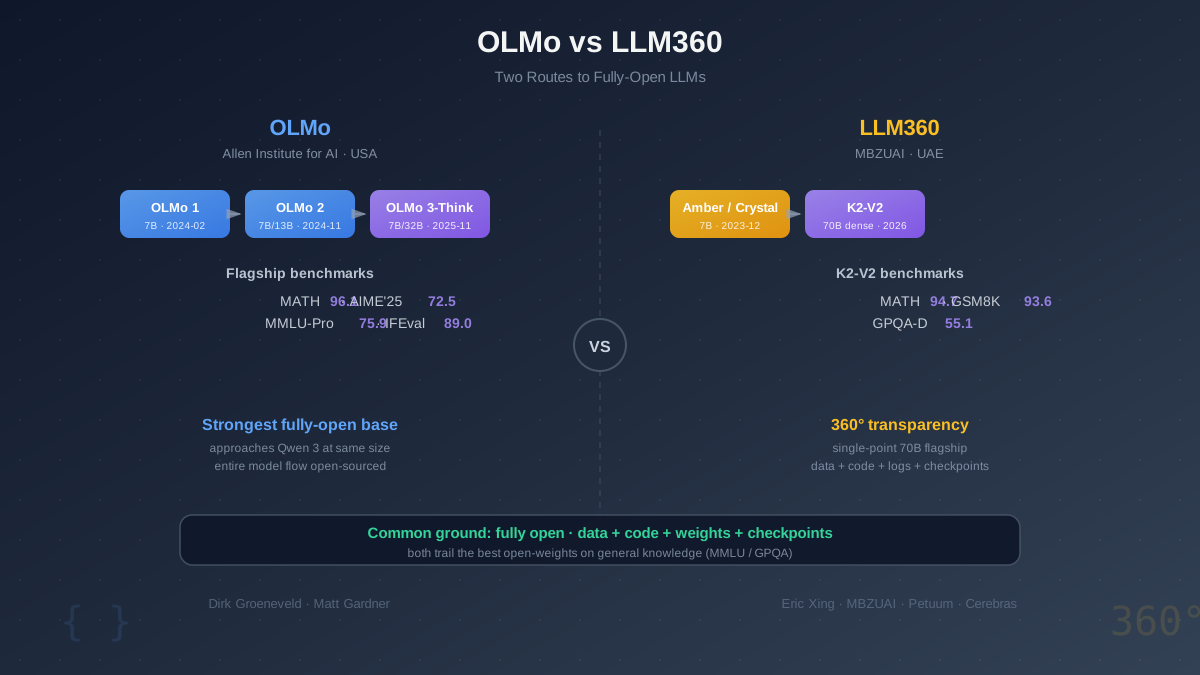
In the “fully open-source” LLM lane, two projects are almost always mentioned together: OLMo (Allen Institute for AI, USA) and LLM360 (MBZUAI, UAE). Both advocate releasing training data, code, weights, and even intermediate checkpoints — yet they differ in generation, scale, performance, and iteration cadence. This post lays them side by side so newcomers can build a full picture quickly.
TL;DR
| Dimension | OLMo family | LLM360 |
|---|---|---|
| Lead org | Allen Institute for AI (AI2), US nonprofit | MBZUAI (+ Petuum + Cerebras), UAE academic |
| Key figure | Dirk Groeneveld, Matt Gardner, et al. | Eric Xing — MBZUAI President / Petuum founder |
| Latest version | OLMo 3 / 3.1 (2025-11/12) | K2-V2 (early 2026, 70B dense) |
| Scale range | 7B / 13B / 32B (+ multimodal Molmo) | 7B (Amber/CrystalCoder) → 70B (K2-V2) |
| Performance | Strongest in the fully-open camp, approaching Qwen 3 at same size | Gen-1 was weak; K2-V2 catches up at 70B |
| Transparency | Fully open (data + code + checkpoints) | Fully open — the “360°” slogan goes further |
One-liner: for benchmark performance pick OLMo; for studying the training process both work, and LLM360’s K2-V2 is a single-point flagship at 70B.
The OLMo Family (AI2)
One-liner positioning
The best-known fully-open LLM family in academia. Every generation releases pretraining data, code, and intermediate checkpoints. It has iterated from OLMo 1 (2024-02) to OLMo 3 (2025-11), and expanded into vision/multimodal (Molmo / OLMoVision).
OLMo 2 (7B / 13B, 2024-11)
Officially positioned as “the best fully-open model to date,” benchmarked against Llama 3.1, Gemma 2, and Qwen 2.5 at the same size. Core evaluations span 11 academic benchmarks: Average / ARC-C / HellaSwag / WinoGrande / MMLU / DROP / NQ / AGIEval / GSM8k / MMLUPro / TriviaQA.
| Model | Avg | ARC-C | HellaSwag | MMLU | DROP | GSM8k |
|---|---|---|---|---|---|---|
| OLMo-2-1124-7B | 62.9 | 79.8 | 83.8 | 63.7 | 60.8 | 67.5 |
| OLMo-2-1124-13B | 68.3 | 83.5 | 86.4 | 67.5 | 70.7 | 75.1 |
| Llama-3.1-8B | 61.8 | 79.5 | 81.6 | 66.9 | 56.4 | 56.5 |
| Qwen-2.5-7B | 67.4 | 89.5 | 89.7 | 74.4 | 55.8 | 81.5 |
| Gemma-2-9B | 67.8 | 89.5 | 87.3 | 70.6 | 63.0 | 70.1 |
A few key observations:
- vs Llama-3.1-8B: OLMo-2-7B averages 62.9 vs 61.8 — roughly tied or slightly ahead, but at only ~1/4 the training FLOPs. Better compute efficiency.
- vs Qwen-2.5-7B: trails by ~4-5 points (Qwen is clearly stronger on MMLU, ARC-C, GSM8k), but Qwen also uses ~4.5× the FLOPs.
- Generational leap: nearly every benchmark doubled vs the original OLMo-7B (GSM8k 9.2 → 67.5, MMLU 28.3 → 63.7).
- Weak spots: MMLUPro (31-35) and NQ (factual QA) are on the weaker side.
OLMo 3 / 3.1 (2025-11 / 2025-12)
This is OLMo’s biggest generational jump yet. It’s no longer just “a set of weights” — it open-sources the entire model flow: data, code, and checkpoints at every stage, all forkable.
Four product lines:
| Line | Size | Purpose |
|---|---|---|
| OLMo 3-Base | 7B / 32B | Base model — strongest fully-open base |
| OLMo 3-Think | 7B / 32B | Flagship reasoning model with inspectable reasoning traces |
| OLMo 3-Instruct | 7B | Chat / tool use |
| OLMo 3-RL Zero | 7B | Starting point for RL research |
OLMo 3-Think 32B core benchmarks:
| Benchmark | OLMo 3-Think 32B | Qwen 3 32B | DeepSeek R1 Distill 32B |
|---|---|---|---|
| MATH | 96.1 | 95.4 | 92.6 |
| AIME 2024 | 76.8 | 80.8 | 70.3 |
| AIME 2025 | 72.5 | 70.9 | 56.3 |
| MMLU-Pro | 75.9 | — | — |
| GPQA (Diamond) | 61.0 | 67.3 | 61.8 |
| IFEval | 89.0 | 86.5 | 78.7 |
| HumanEvalPlus | 91.4 | 91.2 | 92.3 |
OLMo 3-Think 7B: MATH 94.4 ties Qwen 3 8B; AIME 2024/2025 within a few points. Instruct 7B even beats Qwen 3 8B on Safety (87.3 vs 78.0).
The 2025-12-12 (3.1) update: extended the 32B Think’s RL training by another 21 days, yielding AIME +5, IFEval +4, IFBench +20, plus the first large-size Instruct (32B).
OLMo Hybrid (2026-03, an architecture-research branch)
Note this is not OLMo 4 (OLMo 4 is unannounced). It’s a controlled experiment: take the OLMo 3 7B recipe as the control, change only the architecture (transformer layers → hybrid SSM/attention, Mamba-style), keeping all data/code/hyperparams identical.
| Metric | Result |
|---|---|
| Data efficiency | ~2× — reaches the same accuracy as OLMo 3 with 49% fewer tokens |
| Compute equivalence | 1.25× |
| Positioning | Architecture research, not a product line |
It’s the first time hybrid SSM architecture entered the mainstream open-source LLM roadmap, providing controlled evidence that hybrid models scale more efficiently than pure transformers — alongside NVIDIA Nemotron-3 and Jamba, marking “hybrid architectures moving from paper to production.”
LLM360 (MBZUAI + Petuum + Cerebras)
Lead org & positioning
LLM360 is an open research initiative co-founded by three institutions:
| Org | Role |
|---|---|
| MBZUAI (Mohammed bin Zayed University of AI) | Lead — Abu Dhabi, UAE, the world’s first graduate-level AI university. The K2 series is built by its Institute of Foundation Models (IFM) |
| Petuum, Inc. | Co-founder — an AI startup founded by Eric Xing |
| Cerebras Systems | Compute / hardware support (wafer-scale chips) |
The key figure is Eric Xing: MBZUAI President, Petuum founder, former CMU professor. LLM360 and OLMo form an East/West contrast of the two academic open-source camps.
⚠️ Important clarification: the “K2 trillion-parameter, SWE-Bench 65.8%” you often see in search results refers to Moonshot AI’s Kimi K2 (a commercial open-weight MoE, 1T total params) — not an LLM360 product. They just share a name.
Generation 1: Amber & CrystalCoder (both 7B, 2023-12)
| Model | Strength | Performance |
|---|---|---|
| Amber-7B (general base) | Relatively competitive on MMLU | ARC clearly behind peers; MT-Bench only 2.49 (weak) |
| AmberChat / AmberSafe | Chat / safety finetunes | MT-Bench 4.95 / 4.97 |
| CrystalCoder-7B | Code | Clearly beats Amber on MMLU / HumanEval / MBPP; coding is the highlight |
Honestly, Gen-1 LLM360 was on the weak side at 7B — its value was “transparency,” not “performance.”
New generation: K2-V2 (early 2026, 70B dense)
LLM360’s most important update since 2024:
| Item | Detail |
|---|---|
| Release | Early 2026 (marking LLM360’s 2nd anniversary) |
| Params | ~65–70B (dense) |
| License | Apache 2.0 (free commercial use worldwide) |
| Positioning | A “360-open” fully-transparent LLM, focused as a superior base for reasoning adaptation |
Key benchmarks (mid-4 checkpoint):
| Benchmark | K2-V2 (mid-4) |
|---|---|
| GPQA-Diamond | 55.1 |
| GSM8K | 93.6 |
| MATH | 94.7 |
There’s also K2 Think V2 (an end-to-end reasoning system built on K2-V2, positioned as “the UAE’s first fully sovereign reasoning system,” with partners including G42 and Cerebras).
⚠️ Important: K2-V2’s GPQA-Diamond 55.1 / MATH 94.7 (mid-4 checkpoint) can’t be directly compared with OLMo 3-Think 32B — eval setups, checkpoint stages, and whether reasoning mode is on all differ. Always cite each project’s own technical report.
Side-by-side: how to choose
| You want… | Recommendation |
|---|---|
| Strongest base + reasoning model in the fully-open camp | OLMo 3-Think 32B |
| A high-efficiency 7B at the same compute budget | OLMo 3-Think 7B |
| A single-point 70B fully-transparent research flagship | LLM360 K2-V2 |
| Pure coding tasks with a small model | OLMo 3 family overall (HumanEvalPlus 91.4 leads; Gen-1 CrystalCoder is outdated) |
| To study the training process itself / do RL experiments | Both release checkpoints; OLMo 3-Think 32B is officially “the workhorse for RL research” |
| Just the absolute highest score | Look elsewhere — Qwen 3 / DeepSeek open-weights are stronger |
My take
Both projects are benchmarks of open-science spirit, but differ clearly in engineering investment and iteration cadence:
- OLMo’s generational progress is visible to the naked eye. From 1 → 2 → 3, each generation raises the ceiling of the fully-open camp by a big margin, and Gen-3 has begun catching Qwen 3. AI2’s pace feels more like a product team.
- LLM360’s value is “the whole process is researchable.” Gen-1 Amber/CrystalCoder was genuinely weak, but K2-V2 jumping to 70B gives it real competitive teeth. The “360°” slogan isn’t marketing — even training logs are open, making it excellent reproduction/teaching material.
- Both share a weak spot: general knowledge. Both lose to the strongest open-weights on MMLU / GPQA. That’s the price of full-open (including data): you can’t use high-quality proprietary data.
If you’re doing research reproduction or teaching, OLMo 2/3 + LLM360 K2-V2 are currently the two most complete textbook-grade open LLM stacks.